When a Tuscaloosa roof reaches the end of its service life, the decision rarely feels simple. You're weighing storm damage against wear, insurance paperwork against out-of-pocket cost, and one contractor's quote against another's -- often without a clear sense of what any of it should actually cost. This page breaks down roof replacement in Tuscaloosa from every angle a homeowner or property manager actually needs: what a full tear-off and replacement includes, how architectural shingle systems compare to metal and low-slope commercial membranes, what drives your price up or down, how insurance claims for wind and hail damage really move through the system, and what a legitimate warranty -- including a 50-year GAF system warranty -- does and doesn't cover. Wherever we mention pricing, financing, or a step in the process, it's written to be transparent enough that you could walk into a claims adjuster meeting or a contractor walkthrough and already know what questions to ask.
What a Full Roof Replacement in Tuscaloosa Actually Includes
"Roof replacement" gets used loosely, so it's worth being precise. A genuine full roof replacement is not a layover (shingling over existing material) and it is not a patch job scaled up. It's a complete system rebuild:
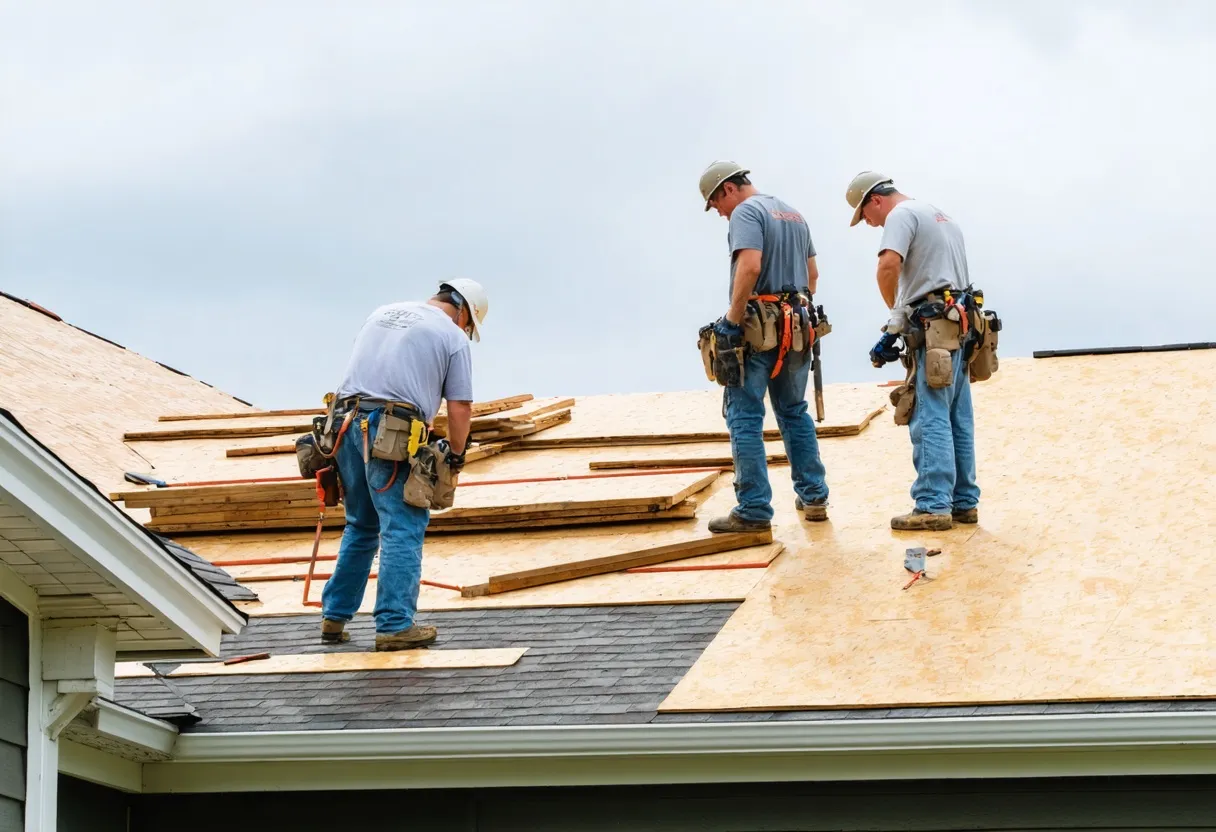
- Tear-off: removal of all existing shingles, underlayment, and any deteriorated decking down to sound wood, with full disposal and haul-away of debris.
- Deck inspection and repair: every sheet of decking gets checked for soft spots, delamination, or rot -- common around Tuscaloosa after long-standing leaks near chimneys, valleys, and skylights -- and any compromised sections are replaced before anything new goes down.
- Ice and water shield / synthetic underlayment: a moisture barrier installed at eaves, valleys, and penetrations, plus a synthetic underlayment across the full deck as the roof's secondary water defense.
- Drip edge and flashing: new metal drip edge at eaves and rakes, plus new step flashing, counter-flashing, and pipe boots at every wall intersection, chimney, and vent -- flashing failure is one of the most common sources of "mystery leaks" on an otherwise sound roof.
- Ventilation components: ridge vents, soffit vents, or powered attic fans as needed to keep the new system within its warranty-required ventilation specs.
- Field material installation: the shingles, metal panels, or membrane itself, installed to manufacturer specification -- nail pattern, exposure, and starter courses all matter for both wind rating and warranty validity.
- Cleanup and magnetic sweep: full property cleanup, gutter check, and a magnetic nail sweep of the yard and driveway.
Every one of those steps affects how long the roof lasts and whether a warranty claim gets honored later. A quote that skips deck inspection or reuses old flashing is a quote that's cheaper for a reason.
Roof Replacement vs. Roof Repair: Knowing Which You Need
Not every damaged or aging roof needs full replacement, and a transparent contractor should tell you that upfront rather than upsell a tear-off you don't need yet. Repair is usually the right call when damage is isolated -- a handful of wind-lifted shingles, a single cracked pipe boot, a localized flashing leak -- and the rest of the roof still has useful life left. Replacement becomes the right call when:
- The roof is past 70-80% of its expected material lifespan (roughly 15-20 years for standard three-tab or architectural shingles in this climate).
- Granule loss is widespread rather than isolated, exposing the asphalt mat across multiple slopes.
- Storm damage is spread across the whole roof rather than confined to one section, which is common after the wind and hail events that move through West Alabama.
- There are multiple layers of shingles already (Alabama building code generally limits roofs to two layers, and most insurers won't underwrite a third).
- Repeated repairs haven't solved a recurring leak, which usually signals a systemic underlayment or decking problem rather than a single point of failure.
If you're not sure which category your roof falls into, that's exactly what a proper inspection is for -- see the next section, and our dedicated roof inspection service in Tuscaloosa for a deeper look at how that process works.
Roof Inspection: The Step Before Any Real Decision
A serious roof inspection covers more than a glance from the ground. It should include a physical walk of the roof surface (weather and pitch permitting), attic inspection for moisture staining and ventilation performance, a check of every flashing point and penetration, and photo documentation you actually get to keep. That documentation matters twice: once for deciding whether you need repair or replacement, and again if you end up filing an insurance claim, where dated photo evidence of damage is often the difference between an approved and a denied claim. If you want the full breakdown of what's checked and how findings get reported, that's covered in detail on our Tuscaloosa roof inspection page.
Storm Damage Restoration and Insurance Claims Assistance
Wind and hail damage to roofing is a recurring reality in this part of the state, and storm-driven insurance claims make up a meaningful share of the roof replacements done across Tuscaloosa County and the surrounding West Alabama communities. That reality shapes how this kind of work should be handled -- and it's the reason insurance-claims navigation is treated as a core part of the service here, not an afterthought.
Storm damage restoration starts with documentation, not demolition. After a wind or hail event, the priority is getting a thorough inspection done and photographed before any tarping or temporary repair disturbs the evidence an adjuster will need to see. From there, the claims process generally follows this path:
- Damage documentation: a full inspection with dated, close-up photos of hail bruising, wind-lifted or missing shingles, damaged flashing, and any related interior damage (ceiling stains, attic moisture).
- Claim filing: the homeowner files with their carrier, ideally with the contractor's inspection report in hand so the initial claim description matches what's actually on the roof.
- Adjuster meeting: the insurance adjuster inspects the roof, typically alongside the contractor if scheduled that way, so damage that's easy to miss from the ground -- soft hail hits on the back slope, for instance -- doesn't get left off the estimate.
- Scope of loss and estimate reconciliation: the insurer issues a scope of work and payment estimate (often using Xactimate or similar estimating software); a knowledgeable contractor reviews this against their own inspection findings and pushes back on missing line items -- code-required upgrades, unlisted flashing, insufficient ventilation replacement -- before work starts, not after.
- Approval and scheduling: once scope and payment are agreed, the replacement gets scheduled, with the contractor billing according to the approved claim (initial ACV payment, then recoverable depreciation released after completion, if the policy is replacement-cost).
- Final inspection and depreciation release: after completion, a final invoice and photos go back to the carrier to release any holdback (recoverable depreciation) owed under the policy.
The single most common way homeowners lose money in this process isn't fraud or bad faith -- it's an incomplete initial scope. Adjusters inspect a lot of roofs in a short window after a storm and can miss things. Having a contractor who documents thoroughly and knows how to write a supplement request when the insurer's scope falls short of the actual damage is often worth more than any discount on labor.
Full Roof Replacement Process, Start to Finish
Whether a job originates from a storm claim or straightforward age-related wear, a full roof replacement in Tuscaloosa generally moves through these stages:
1. Inspection and Estimate
A detailed inspection identifies current condition, deck integrity, ventilation status, and any code-required upgrades. The estimate that follows should break out material, labor, tear-off, disposal, and any deck repair as separate line items -- not a single lump sum -- so you can see exactly what you're paying for.
2. Material Selection
This is where roof type, shingle line, color, and warranty tier get finalized. It's also where cost differences between architectural shingles, metal, and premium designer lines become concrete rather than abstract.
3. Permitting and Scheduling
Depending on jurisdiction within Tuscaloosa County, a roofing permit may be required for full replacement. A legitimate contractor pulls this rather than skipping it -- unpermitted work can complicate both future home sales and insurance claims down the road.
4. Delivery and Staging
Materials are delivered and staged, dumpsters or trailers positioned for debris, and landscaping/property protected (tarps over shrubs, plywood over driveways where needed).
5. Tear-Off and Deck Repair
Old roofing comes off down to the deck. Any rotted or delaminated decking is replaced at this stage -- this is also the point where hidden damage from long-term leaks becomes visible, so a transparent contractor will show you photos of any deck issues before proceeding, not just add a surprise line item to the final bill.
6. Underlayment, Flashing, and Field Installation
Moisture barrier, synthetic underlayment, new flashing, and finally the field material go on to manufacturer spec -- this is the step that determines whether your warranty is actually valid, since most manufacturer warranties (including GAF's higher tiers) require certified installation practices.
7. Ventilation and Add-On Installation
Ridge vents, skylights, or attic ventilation upgrades get installed as part of the same sequence rather than as an afterthought, since proper ventilation is tied directly to shingle warranty terms.
8. Final Cleanup and Walkthrough
Full site cleanup, magnetic nail sweep, and a walkthrough where you can see completed work and ask questions before final sign-off.
9. Warranty Registration
Manufacturer warranty paperwork -- especially for extended coverage like GAF's 50-year systems -- gets filed promptly. This step gets skipped more often than it should; always confirm in writing that registration was completed.
Architectural Shingle Roof Replacement
Architectural (also called "dimensional" or "laminate") shingles are the standard choice for most Tuscaloosa homes today, and for good reason. Unlike flat three-tab shingles, architectural shingles are built from multiple laminated layers, giving them a heavier, more dimensional look and meaningfully better wind resistance -- typically rated up to 110-130 mph depending on the product line, compared to roughly 60-70 mph for basic three-tab. That wind rating matters directly in a region that sees regular thunderstorm and occasional tornadic wind events.
Architectural shingles also carry longer manufacturer warranties (commonly 30 years to lifetime, versus 20-25 years for three-tab) and a wider range of color blends designed to complement brick, siding, and stone finishes common in this market. The tradeoff is cost -- architectural shingles typically run 20-40% more than three-tab -- but the combination of better wind performance, longer lifespan, and stronger resale appeal makes them the default recommendation for most full replacements here.
Metal Roofing as an Alternative
Standing-seam metal roofing has grown more common on both residential and commercial properties in the area, mainly for its longevity (40-70 years), superior wind and impact resistance, and energy efficiency from reflective coatings. It costs considerably more upfront than shingles but requires far less lifecycle maintenance and can outlast two or three shingle replacements over the life of a home. For homeowners planning to stay long-term, or for properties where storm resilience is the priority, it's worth pricing out alongside architectural shingles rather than assuming shingles are automatically the better value.
Commercial Roofing: EPDM, TPO, PVC, and Metal Systems
Commercial and low-slope roofing is a different discipline from residential steep-slope work, and it covers a different set of materials:
- EPDM (rubber membrane): a proven, cost-effective single-ply membrane for low-slope commercial roofs, valued for durability and ease of repair, typically installed in large fully-adhered or mechanically-fastened sheets.
- TPO (thermoplastic polyolefin): currently the most widely specified commercial membrane, offering strong reflectivity (helpful for cooling costs on large flat roofs), heat-welded seams, and competitive pricing relative to PVC.
- PVC: a premium single-ply option with strong chemical and grease resistance, often specified for restaurants or industrial buildings with rooftop exhaust exposure.
- Metal: standing-seam or through-fastened panel systems for commercial buildings wanting long service life and low maintenance, often paired with insulation upgrades for energy code compliance.
Commercial roof replacement typically involves more logistics than residential -- rooftop equipment (HVAC curbs, exhaust fans, drains) has to be worked around, and many projects are phased to keep the building operational during replacement. Insurance and warranty considerations differ too: commercial membrane systems are usually specified with NDL (no dollar limit) manufacturer warranties on higher-tier installations, which is worth confirming in writing before signing a commercial contract.
Emergency 24/7 Response
Roof failures don't wait for business hours. Active leaks during a storm, a tree limb through a roof deck, or wind-torn shingles exposing the underlayment all need a fast temporary fix -- tarping, emergency board-up, or targeted patching -- to stop water intrusion before it turns into interior damage, mold, or structural rot. Emergency response is treated as a distinct service tier from scheduled replacement precisely because the goal is different: stop the bleeding now, then plan the permanent fix (repair or full replacement) once the property is stabilized and, if applicable, once the insurance claim is documented. If you're dealing with an active leak, get emergency tarping done before you worry about material selection or financing -- those decisions can wait a day or two; standing water in an attic cannot.
What Drives the Cost of a New Roof in Tuscaloosa
"New roof cost in Tuscaloosa" doesn't have a single answer because too many variables move the number. The honest way to think about pricing is by the factors that actually change it:
- Roof size (squares): roofing is priced in "squares" (100 sq ft each). A small single-story home might be 15-20 squares; a larger two-story home can run 30-45+ squares. Size is the single biggest cost driver.
- Material choice: three-tab shingles sit at the low end; architectural shingles are the mid-to-upper mainstream choice; premium designer shingle lines, metal, and slate/tile sit progressively higher.
- Roof pitch and complexity: steep pitches require additional safety equipment and slow installation; roofs with many valleys, dormers, hips, or chimneys take longer and use more flashing material than a simple gable roof of the same size.
- Deck condition: any plywood or OSB replacement needed after tear-off adds material and labor cost that's genuinely hard to quote precisely until the old roofing is off.
- Tear-off layers: removing two existing layers of shingles costs more in labor and disposal than removing one.
- Accessibility: steep driveways, limited yard access for dumpsters, or tall multi-story sections all affect labor time.
- Ventilation and code upgrades: adding or upgrading ridge vents, soffit vents, or bringing older ventilation up to current code adds to the project.
- Warranty tier: manufacturer-certified installation for extended warranties (like GAF's higher system tiers) typically carries a modest premium over standard installation, reflecting the additional inspection and certification requirements.
Rather than quote a single number that would be misleading given how much these variables swing pricing, the most useful thing a homeowner can do is get a measured, itemized estimate broken out by these categories -- that's what makes one quote genuinely comparable to another. For a full breakdown of pricing structure, financing options, and warranty tiers side by side, see our dedicated roofing cost, financing, and warranty guide for Tuscaloosa.
Financing a Roof Replacement
A full roof replacement is a significant expense, and very few homeowners pay entirely out of pocket without at least considering financing. Common paths include contractor-arranged financing plans with fixed monthly payments, home equity lines of credit, and, for storm-damage claims, insurance proceeds covering some or all of the cost after deductible. Financing terms, promotional periods, and qualification requirements vary enough between lenders that they're worth comparing directly rather than accepting the first offer presented -- our cost and financing page walks through how those options typically compare so you can budget accurately before committing to a project.
Request Your Free Roof Quote
No pressure, no hidden line items, just a straight answer about your roof.
Get A Clear Look At Your Roof
Request a free, itemized quote and find out what's actually going on up there.